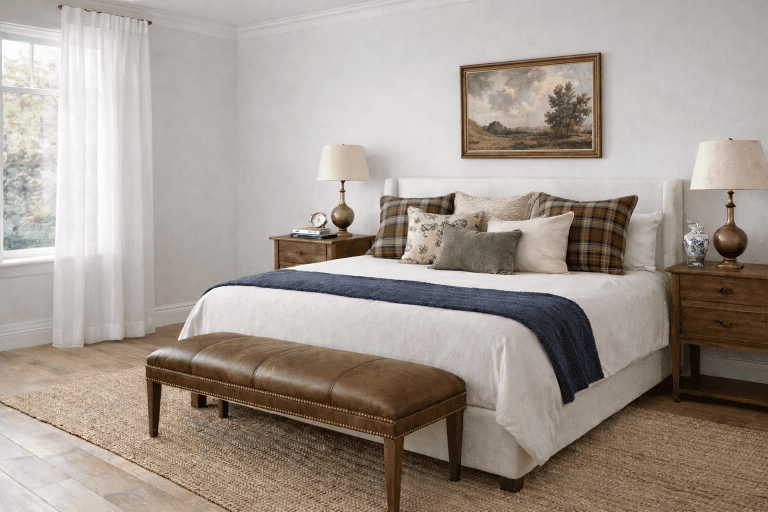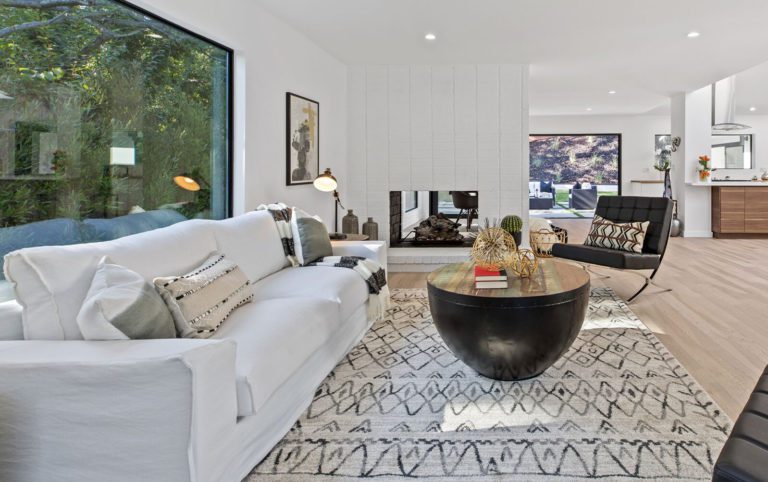
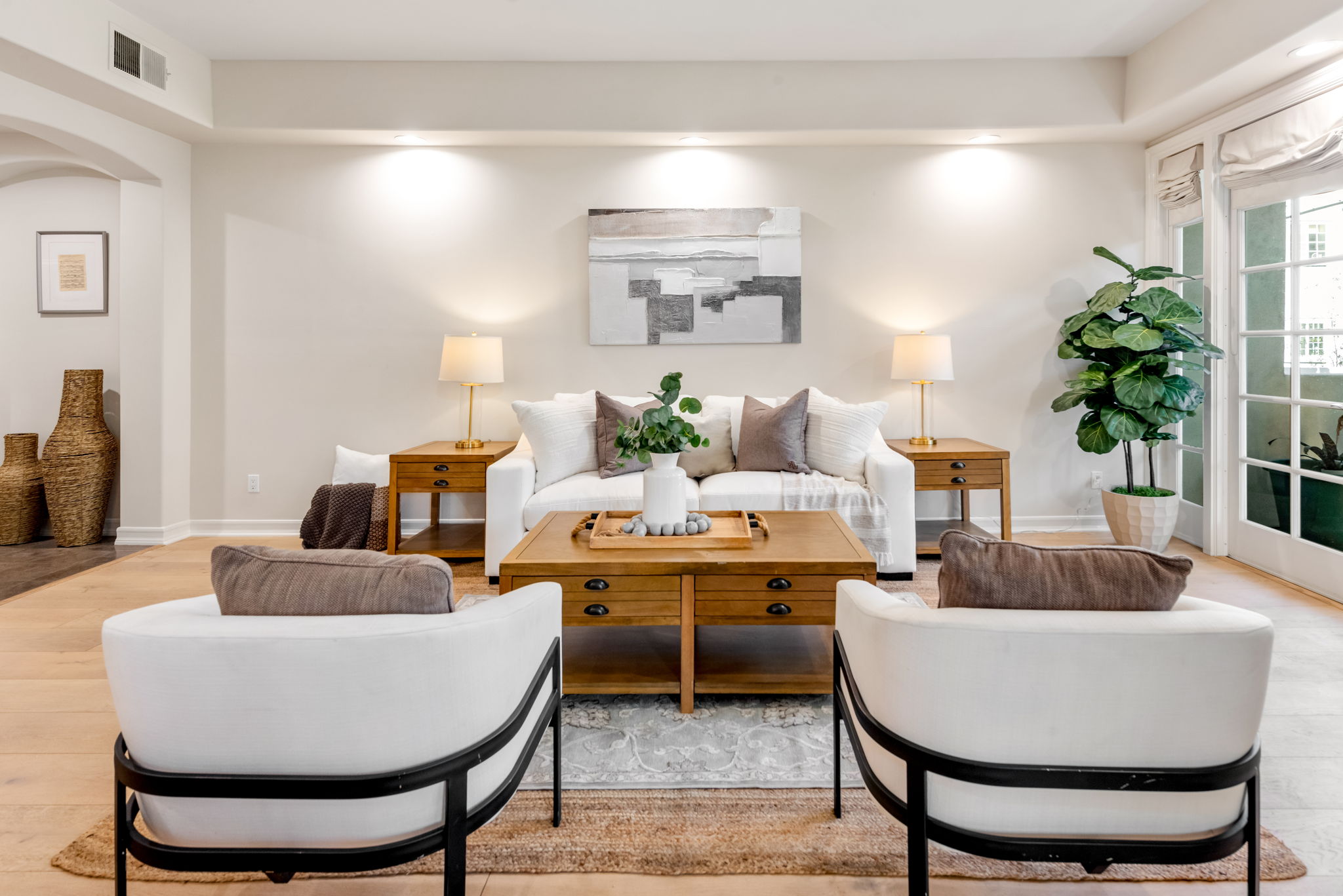
An empty room can leave buyers with questions about scale, furniture placement, and daily use. Thoughtful staging offers visual reference points, helping them understand how the space might work for their lives.
Schedule a staging consultation with KMW Interiors
In the 2025 NAR Profile of Home Staging, 83% of buyers’ agents said staging helped buyers imagine a property as their future home. That supports the value of visual context. It does not establish that every vacant room appears smaller or that all buyers respond in the same way.
Key Takeaways
• Empty rooms can be harder to interpret without furniture for reference
• Buyers rely on visual cues to understand function
• Vacant homes can feel incomplete—even when they’re not
• Staging can clarify the presentation and support buyer confidence
How furnishings help buyers understand scale
An empty room may look spacious, yet still leave buyers unsure how a sofa, dining table, or bed will fit. Perceived size varies with the room, lighting, viewpoint, and furniture arrangement.
Without furnishings as reference points, some buyers find it harder to judge furniture fit and circulation. A carefully scaled arrangement can answer those practical questions while leaving the architecture visible.
This is particularly useful in homes where volume, light, and the relationship between rooms are central to the experience. The goal is to make those qualities legible without overstating what staging can change.
Expert Insight
Furniture provides a reference for how a room can be used. It should clarify proportion and circulation while respecting the room’s actual dimensions.

The quiet problem: when a room has no clear purpose
When a space is empty, buyers are forced to answer a question on their own:
“What is this room supposed to be?”
And more importantly:
“Would I actually use it?”
That pause—however brief—introduces hesitation.
A room without defined purpose becomes a question mark. And in real estate, question marks slow decisions.
Staging can make that purpose clear.
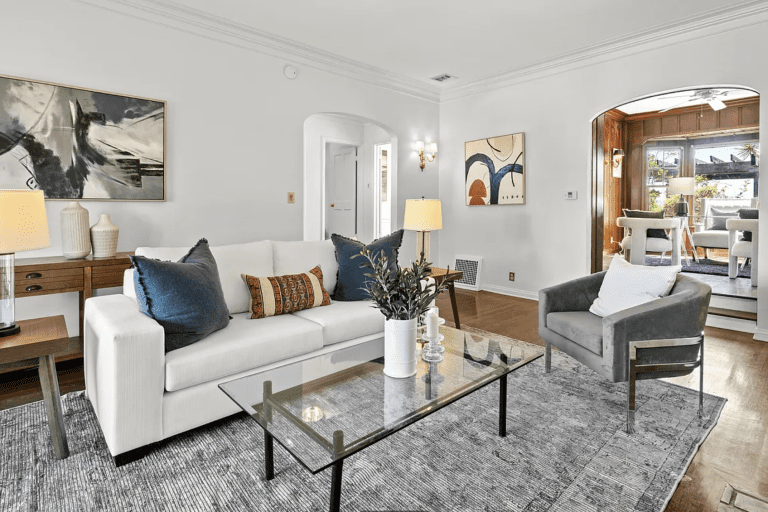
A living room becomes a place to gather. A corner becomes a reading area. A dining space becomes an environment for hosting.
Clarity replaces uncertainty.
What emptiness communicates—whether intended or not
Buyers don’t just evaluate what’s present. They also respond to what’s missing.
Empty homes can unintentionally signal:
• a lack of warmth
• a lack of completion
• or a home that hasn’t been fully considered
Even when finishes are beautiful and the property is well-maintained, some buyers find it harder to connect with a space without furnishings.
It’s not logical—it’s perceptual.
And perception is what drives decisions.
Why buyers struggle to connect emotionally with vacant homes
Buying a home is not purely analytical.
Buyers are imagining:
• where they will sit
• how they will move through the space
• how the home will support their daily life
Without visual context, that process becomes harder.
The mental effort increases—and with it, friction.
Staging removes that friction by giving buyers a framework.
Instead of imagining from scratch, they respond to what’s already been established.
Expert Insight
Buyers don’t just evaluate homes—they project themselves into them. When that projection requires too much effort, connection weakens.
How staging changes perception—immediately and quietly
Staging doesn’t alter the architecture of a home.
It alters how the architecture is understood.
Through proportion, placement, and restraint, staging:
• defines how each room functions
• reinforces scale
• creates visual rhythm
• supports a cohesive flow
None of these elements are loud—but together, they shape how a home is experienced.
And more importantly, how it is remembered.
Expert Insight
Strategic staging is not about adding more—it’s about removing ambiguity. When spaces feel intentional, buyers tend to interpret the entire home as more valuable.
Read Insights post: “Why Home Staging Should Be The Final Step Before Listing a Property”
Checklist: preparing a vacant home for market
Before listing a vacant property:
☐ Identify the most influential rooms (living, dining, primary bedroom)
☐ Define a clear function for each key space
☐ Use furniture that reflects the scale of the home
☐ Maintain visual restraint—avoid overfilling
☐ Prepare the home for both photography and showings
Start with the rooms that matter most in a luxury home, then consider how the remaining spaces connect. If scope is a concern, our discussion of partial staging and empty homes helps frame that decision.
Mistakes to avoid with vacant listings
- Leaving primary living spaces empty
- Assuming buyers can visualize scale on their own
- Ignoring rooms with ambiguous layouts
- Using underscaled furniture
- Overcompensating with excessive styling
FAQs
Do empty rooms make a home feel smaller?
They can, but not invariably. Perceived size depends on the space and the viewer. Well-scaled furnishings provide a reference for furniture fit and circulation without changing the room’s dimensions.
Why do vacant homes feel less inviting?
Vacant homes lack visual warmth and context, making it harder for buyers to emotionally connect.
Does staging help define how a home is used?
Yes. Staging clarifies room purpose and helps buyers understand how spaces function in daily life.
Is staging necessary for every room?
Not always. Prioritizing key living areas typically creates the strongest overall impact.
Do buyers prefer staged homes?
In many cases, yes. Staged homes reduce uncertainty and create a more immediate emotional response.
Does staging affect how homes photograph?
Absolutely. Staging improves composition, scale, and visual clarity in listing photos.
Service Areas
KMW Interiors provides home staging and interior design services across West Los Angeles (Santa Monica, Venice, Culver City, Malibu, Pacific Palisades, Brentwood, Mar Vista, Playa Vista, Del Rey, Westchester, West Hollywood, Beverly Hills, Westwood, Holmby Hills, Bel Air, Hollywood Hills), the South Bay (Manhattan Beach, Hermosa Beach, Redondo Beach, Palos Verdes), and select Valley neighborhoods (Burbank, Sherman Oaks, Studio City).
View some of our client reviews here.
KMW’s home staging service begins with the property’s architecture, room proportions, and the experience buyers will have as they move through it.