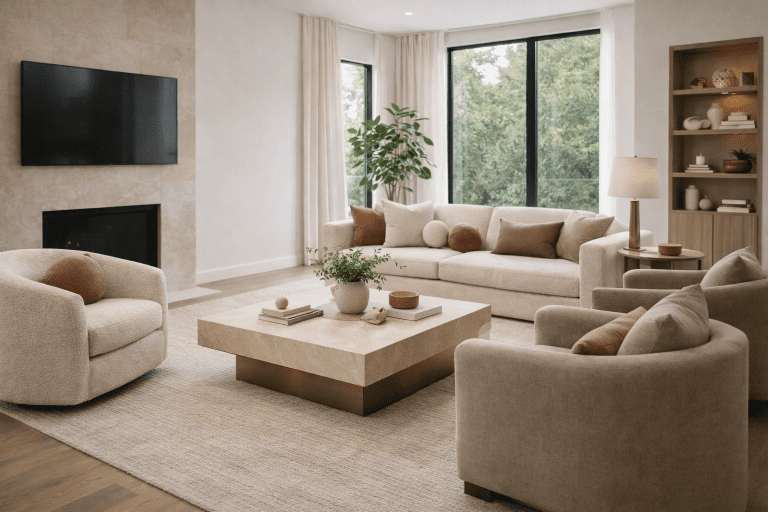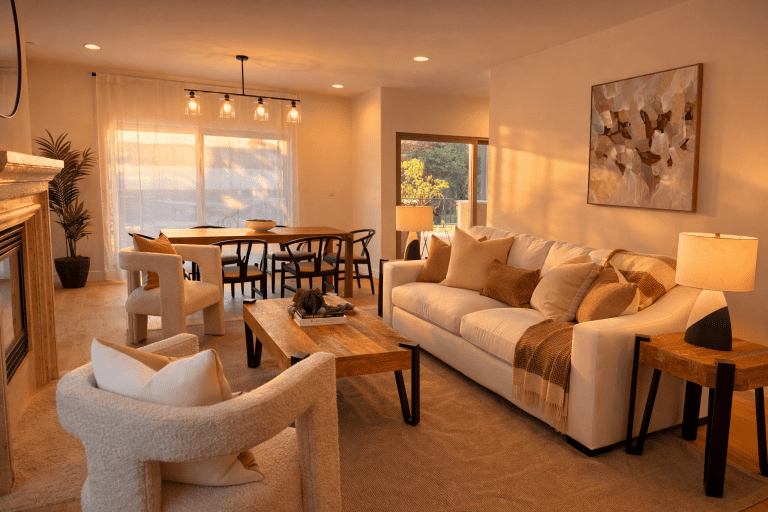
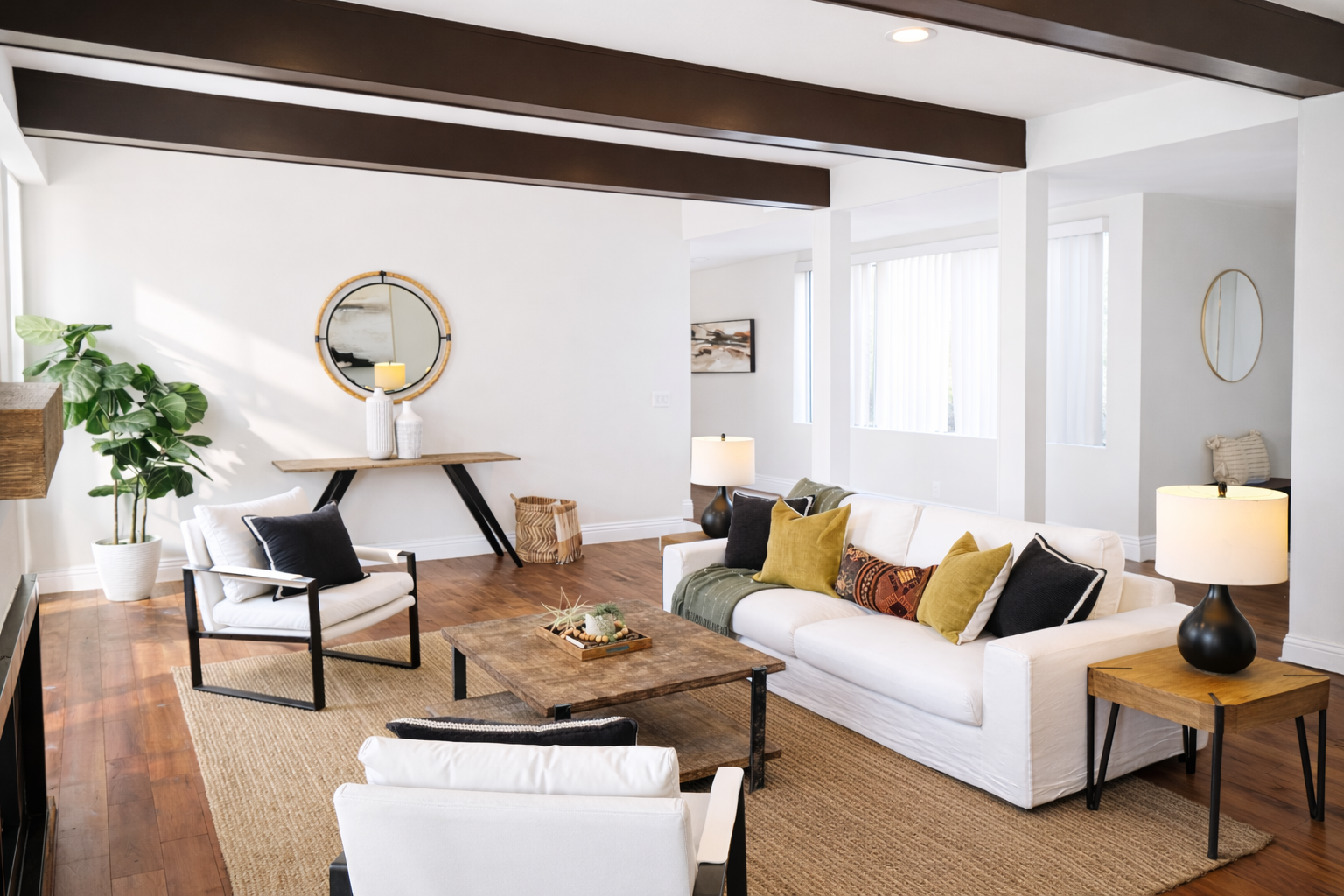
Partial staging is rarely more effective than fully staging a home. While it may seem like a strategic compromise, it often creates visual inconsistency and weakens buyer perception. In most cases, a fully staged home provides clearer function, stronger emotional connection, and better overall presentation. In today’s real estate market, presentation is very important. Staging provides motivation to make such a big purchase!
Schedule a staging consultation to determine the right scope for your property.
Empty Homes Struggle to Connect With Buyers
People get much more picky about small details when the home is empty.
Without furnishings, buyers are left to interpret scale, function, and layout on their own. Most won’t. Instead, they experience uncertainty:
- How large is this room, really?
- Where would furniture go?
- Does this layout actually work?
In Los Angeles markets—where expectations are high—uncertainty quickly turns into hesitation.

What Partial Staging Attempts to Solve
Partial staging is often positioned as a middle ground:
- Stage the living room
- Leave secondary spaces empty
- Reduce overall investment
The intention is to highlight key areas while minimizing scope.
However, the issue isn’t what’s staged—it’s what’s not. You want buyers to see a complete presentation that gives them a clear vision of how to live in the home. The less you leave unfinished, the less buyers question. You want them fantasizing about living in the space in real-time.
See our insights post “What Buyers Assume When They Walk Into Empty Rooms”
Why Partial Staging Often Weakens the Presentation
A home is not experienced room by room—it’s experienced as a whole.
When only portions of the home are staged, buyers begin to notice contrast:
- One room feels resolved, another feels unfinished
- Scale appears inconsistent
- The home lacks a cohesive narrative
Instead of elevating the property, partial staging can unintentionally emphasize what’s missing.
Expert Insight: Cohesion Is What Buyers Actually Respond To
Buyers don’t consciously evaluate staging room by room—they respond to the overall sense of cohesion. When a home shifts from resolved to unresolved as they move through it, it creates subtle friction. That friction often translates into hesitation, even if they can’t immediately explain why.
A fully staged home removes that inconsistency, allowing the experience to feel continuous and complete from entry to exit.

When Partial Staging Can Work
There are limited scenarios where partial staging can be effective:
- Architecturally strong homes with clear spatial definition
- Smaller properties where fewer rooms carry most of the value
- Highly intentional staging plans—not cost-driven decisions
Even then, success depends on discipline and careful execution.
Expert Insight: Partial Staging Only Works When It’s Intentional—Not Economical
Partial staging is most effective when it is driven by a clear design strategy, not by reducing scope. When decisions are made purely to minimize investment, the result is usually imbalance—too much emphasis in one area and not enough resolution elsewhere.
Strategic restraint is different from omission. Buyers can feel the difference immediately.
Why Full Staging Creates Stronger Buyer Response
Fully staged homes remove interpretation.
They show:
- Clear function in every space
- Consistent scale and proportion
- A cohesive material and design language
This creates what buyers respond to most—a sense of completion.
And in competitive Los Angeles markets, completion translates to confidence.
Expert Insight: Completion Signals Value
In high-performing listings, the feeling of “completion” is one of the strongest psychological drivers of perceived value. When a home appears finished, cohesive, and ready, buyers shift from analyzing what needs to be done to imagining themselves living there.
That shift is where stronger offers are often formed.
Checklist: How to Decide Between Partial and Full Staging
☐ Does the home have strong architectural clarity on its own?
☐ Are the most important rooms clearly defined and connected?
☐ Will unstaged areas feel intentional—or incomplete?
☐ Does the overall presentation feel cohesive from room to room?
If the answer is unclear, full staging is typically the stronger strategy.
Expert Insight: Buyers Don’t Reward Half-Measures
In competitive Los Angeles markets, buyers are comparing multiple properties within the same price range. Homes that feel fully resolved consistently outperform those that feel partial or in-progress.
Partial staging may reduce upfront investment—but it can also reduce the strength of the home’s position within that comparison set.
Mistakes to Avoid
- Staging only one focal room and leaving the rest undefined
- Using partial staging as a cost-saving shortcut rather than a strategy
- Ignoring how buyers experience the home as a whole
- Mixing staged and unstaged spaces without a cohesive plan
Key Takeaways
- Partial staging often creates visual inconsistency, which weakens overall buyer perception
- Empty homes lack scale, function, and emotional clarity, making them harder to connect with
- Buyers experience a home as a whole—not individual rooms
- Fully staged homes create a stronger sense of cohesion, completion, and confidence
- Partial staging only works when it is intentionally designed—not cost-driven
- In competitive Los Angeles markets, homes that feel fully resolved consistently outperform those that feel incomplete
FAQs
Is partial staging cheaper than full staging?
Yes—but it often reduces overall impact, which can affect buyer perception and performance.
Does staging only the living room help?
It can help slightly, but it rarely creates a complete or compelling presentation.
Do empty homes sell slower?
They can, especially when buyers struggle to understand layout and scale.
Is full staging always necessary?
Not always—but in most cases, it produces stronger results.
Can partial staging work in luxury homes?
Rarely. Higher-end buyers expect a complete and cohesive presentation.
What rooms matter most for staging?
Living room, primary bedroom, and dining areas typically carry the most weight.
Will buyers bring their own vision to an empty home?
Some will—but most rely on visual cues to understand the space.
Is partial staging better than no staging at all?
Sometimes—but only when executed intentionally and cohesively.
Serving Los Angeles
KMW Interiors provides design-driven home staging across West Los Angeles, the South Bay, and select Valley neighborhoods—helping properties present with clarity, cohesion, and confidence.