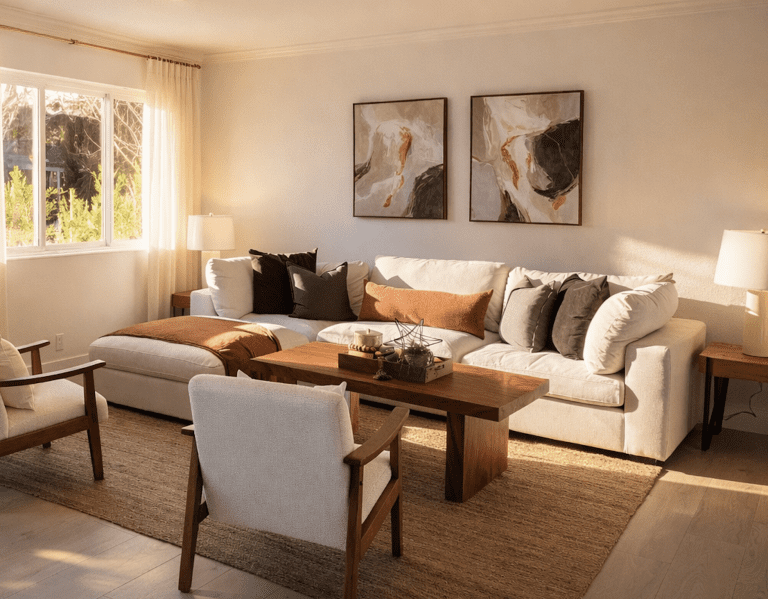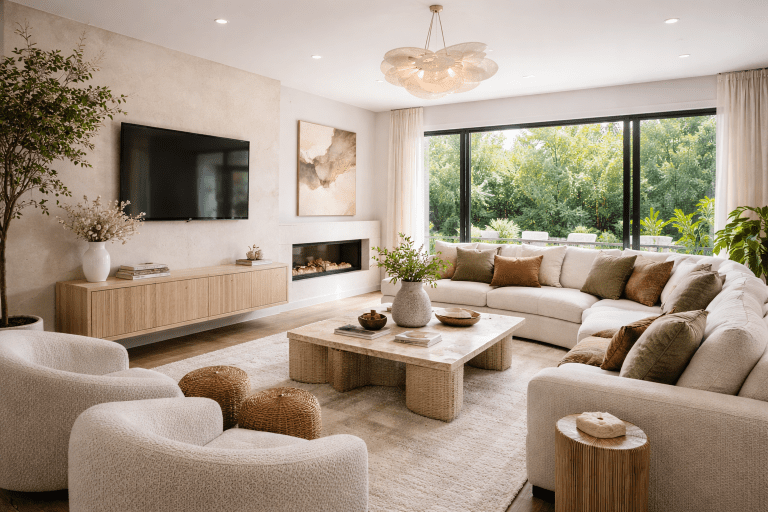
In luxury homes, the rooms that shape buyer perception most strongly are the living room, kitchen, primary bedroom, and outdoor spaces. These areas establish scale, lifestyle, and emotional connection—often determining whether a buyer sees the home as aligned with its price point.
The 2025 NAR Profile of Home Staging distinguishes buyer priorities from staging frequency. Buyers’ agents rated the living room (37%), primary bedroom (34%), and kitchen (23%) as very important to stage. Sellers’ agents most commonly staged living rooms (91%), primary bedrooms (83%), dining rooms (69%), and kitchens (68%). These national findings inform the starting point; the architecture and lifestyle of a Los Angeles luxury home determine the final scope.
Why every room should be staged in a luxury home
In luxury real estate, consistency communicates value. When buyers move from one beautifully resolved space into an empty or underwhelming room, the shift can subtly weaken perceived scale and cohesion. Full staging ensures the home feels intentional from entry to exit.
Luxury buyers expect completeness. Staging every room reinforces proportion, flow, and architectural clarity—protecting the integrity of the asking price. If scope must be prioritized, we focus first on the rooms that carry the strongest emotional weight, but full-home staging delivers the most cohesive and confident presentation.
The Living Room: Establishing Scale and First Impressions
The living room often anchors the buyer’s emotional response. It communicates scale, layout clarity, and how the home supports gathering and everyday comfort.
In larger homes especially, proper furniture proportion is critical. Underscaled pieces or poor layout can unintentionally shrink the perceived value of the space.
Key staging focus:
Correct furniture scale
Clear conversational layout
Balanced lighting
Architectural emphasis (fireplace, windows, ceiling height)
The Kitchen: Reinforcing Value and Lifestyle
While kitchens may not require full furnishing, they must feel intentional and elevated. Buyers evaluate cabinetry, finishes, and flow quickly.
Strategic styling—paired with restraint—helps the kitchen read as refined rather than cluttered.
Key staging focus:
Minimal, curated countertop styling
Cohesive bar seating where appropriate
Visual continuity with adjacent living spaces
The Primary Bedroom: Emotional Security and Calm
The primary suite influences how buyers imagine daily life in the home. It should feel calm, resolved, and proportional to the home’s scale.
A well-staged primary bedroom signals comfort and permanence—especially important in higher price points.
Key staging focus:
Properly scaled bed and nightstands
Layered but restrained textiles
Intentional lighting
Clear circulation space
Outdoor Spaces: Extending the Living Experience
In West Los Angeles, the South Bay, and many Valley neighborhoods, outdoor living is not secondary—it’s expected. Patios, terraces, and yard spaces often carry significant emotional weight.
Thoughtful outdoor staging helps buyers understand how patios and terraces extend the living experience; it does not change the home’s measured interior square footage.
Key staging focus:
- Defined seating zones
- Proportionate outdoor furnishings
- Clean sightlines from interior to exterior
What About Dining Rooms, Offices, and Secondary Bedrooms?
Dining Areas: Making Entertaining and Circulation Clear
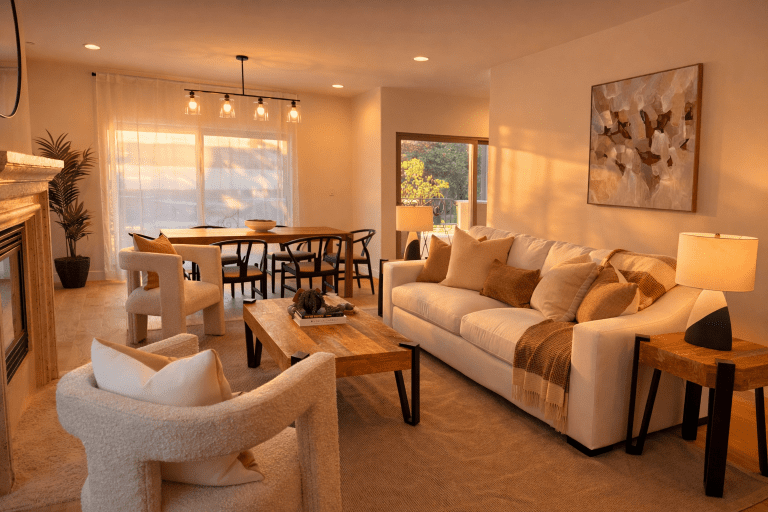
Dining spaces show how the home welcomes guests and how its main rooms connect. This is especially useful in an open-plan home, where a properly scaled table, comfortable chair clearance, and a clear route to the kitchen make the layout easier to read.
The goal is a dining area that belongs to the architecture and feels connected to the living spaces. It should support the flow of the home without crowding it.
Offices and Secondary Bedrooms
Offices and secondary bedrooms should have a clear purpose and feel connected to the main spaces. They can often be styled more minimally, provided that furniture scale, circulation, and the overall presentation remain considered.
That distinction matters when considering partial staging versus leaving a home empty. Our guide to what buyers assume in empty rooms explains why a clear function and useful scale references can matter as much as furniture quantity.
Checklist: Prioritizing Rooms for Luxury Staging
☐ Living room establishes scale and layout clarity
☐ Kitchen reads refined and intentional
☐ Primary suite feels calm and proportional
☐ Outdoor areas extend lifestyle appeal
☐ Secondary rooms support overall cohesion
Mistakes to Avoid
- Staging every room equally without strategic emphasis
- Underscaling furniture in larger homes
- Over-styling kitchens and countertops
- Ignoring outdoor areas in lifestyle-driven markets
- Treating staging as decoration rather than positioning
FAQs
Can you stage only certain rooms in a luxury home?
Sometimes. We assess whether a focused scope will still create a cohesive experience across the home. For vacant luxury properties, a complete presentation is often the stronger design solution.
What rooms do buyers look at first?
Living areas, kitchens, and primary bedrooms typically shape first impressions.
Is it worth staging guest bedrooms?
Often only after primary spaces are resolved and budget allows.
Should outdoor spaces always be staged in Los Angeles?
In many cases, yes—especially where lifestyle and climate are selling points.
Does staging the right rooms help protect price?
Yes. High-impact rooms influence perceived value and buyer confidence.
What if the home is already furnished?
A consultation can determine whether editing, reconfiguration, or supplemental pieces are needed.
How do you decide which rooms to prioritize?
We evaluate layout, buyer profile, price point, and lifestyle positioning. Explore KMW’s home staging approach and project scope for the process from property review through installation.
View some of our client reviews here.
Serving West Los Angeles (Santa Monica, Venice, Culver City, Malibu, Pacific Palisades, Brentwood, Mar Vista, Playa Vista, Del Rey, Westchester, West Hollywood, Beverly Hills, Westwood, Holmby Hills, Bel Air, Hollywood Hills), the South Bay (Manhattan Beach, Hermosa Beach, Redondo Beach, Palos Verdes), and select Valley neighborhoods (Burbank, Sherman Oaks, Studio City).